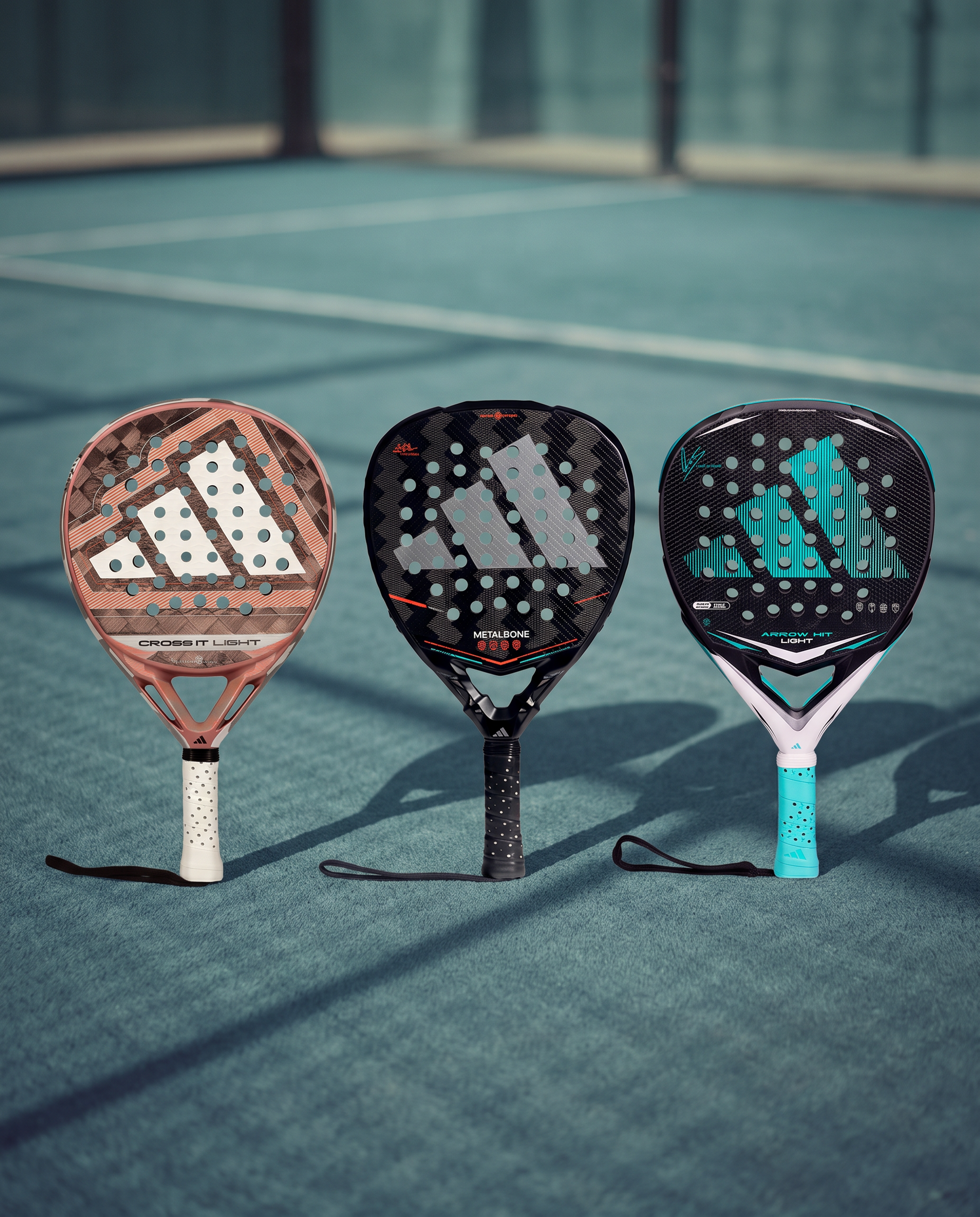
Adidas CrossIT vs Metalbone vs Arrow Hit
Every Adidas series has a control model and an attack model, so picking "control" does not pick a series. The real decision is upstream: CrossIT for forgiveness, Metalbone for a hard-attacking ceiling, Arrow Hit for continuous balance tuning. Here is what actually separates the three, how each plays on court, where Arrow Hit leaves Adipower, and how to pick the series before you get to the variant.
You walked in wanting a control racket. CrossIT has a control model. Metalbone has a control model. Arrow Hit has a CTRL variant. Picking "control" did not narrow anything down, because inside every Adidas series there is a control option and an attack option. The variant choice happens after the series choice, not instead of it. Adidas does not spell out what the series choice actually is. This post does.
The three axes that actually separate the series
Ignore the shape on the box for a moment. What sets CrossIT, Metalbone, and Arrow Hit apart is not diamond versus round, and not CTRL versus ATTK. It is three things that stay constant across every variant in a series.
- Construction stiffness. Metalbone uses a 16K aluminized carbon face, the stiffest layup in the lineup. CrossIT sits softer, with a carbon layup that varies by variant. Arrow Hit uses what Adidas calls "Signature Carbon" and, unusually for a major brand, does not publish the K grade.
- Forgiveness. CrossIT has the widest effective sweet spot and the most tolerance for off-centre contact. Metalbone has the most compact sweet spot; clean central contact is not optional. Arrow Hit sits between them.
- Tunability. CrossIT is fixed. Metalbone has a preset weight system (roughly 11g of adjustment via internal screws and plates). Arrow Hit's Intelligent Balance System is a weight that slides continuously along two side rails, so you shift the character of the racket without stopping at presets.
Pick the series on those three axes. The CTRL versus ATTK call comes after.
CrossIT, the forgiving series
CrossIT is the series for the intermediate to advanced player who wants Adidas performance without a high technical demand. The Dynamic Airflow hole pattern and 3D textured surface add spin and widen the effective sweet spot. Bandejas come off cleanly at medium swing speeds without asking your arm to do all the work. Salida de pared is quick. Víboras at maximum velocity lose a little control, which is the trade-off for how forgiving the racket is at every other speed.
The framing to hold in your head: CrossIT helps you arrive early. It rewards positioning and rhythm rather than finishing power. If you play a lot of fondo, if you cover a lot of court, if your value at the red is placement rather than raw hitting, this is where you start. Marta Ortega plays CrossIT Light.
Metalbone, the demanding series
Metalbone is the opposite bet. Whichever variant you pick, you are hitting with the stiffest, highest-specification construction in the lineup. The sweet spot is compact. Smashes feel heavier, volleys feel more solid, and finishing points at the red is genuinely easier once your contact is clean. When it is not clean, you feel it in the ball and in your arm.
Metalbone helps you finish hard. That is the whole pitch. The preset weight system gives some flexibility across configurations, but it does not turn the racket into something forgiving. If you are an advanced attacking player who trusts your technique and wants the highest ceiling for a decisive por tres, Metalbone is built for that. If your defensive game leans on the racket doing some of the work, look elsewhere. Ale Galán plays Metalbone.
Arrow Hit, the tunable series
Arrow Hit is the series built around adjustability. The Intelligent Balance System slides a weight continuously along two side rails, so you can shift the balance forward for a more aggressive, head-heavy feel or back for something softer and more control-first. The Muscle Power System (carbon ribs in the throat) keeps torsional stability consistent as the weight moves, so you are not fighting the frame when you retune.
On feel, Arrow Hit sits between CrossIT and Metalbone. It is more arm friendly than Metalbone, with a larger sweet spot, but still a serious racket for offensive play. Both the ATTK and CTRL variants carry the same balance system, so the variant choice inside Arrow Hit is about shape (diamond versus round) and starting balance rather than whether you get the tuning hardware. Ari Sánchez plays Arrow Hit.
The Adipower question
Arrow Hit replaces Adipower. That is the direction of travel from Adidas. Adipower units still on shop shelves are old stock, not a continuing line. If Adipower Control was your racket, Arrow Hit CTRL is the natural next step; the feel is stable, predictable, and easy to place the ball with. But Arrow Hit is not a rebadged Adipower. It is a new platform with different construction and a balance system Adipower never had.
One more caveat: Adidas does not disclose the K grade of Arrow Hit's carbon face. Every other major brand publishes this number. If you compare rackets on carbon spec, know that Arrow Hit is the one you cannot line up next to Metalbone's 16K on paper.
How to choose
Three decisions you can make now, before you even open a variant page.
- Control-first or defence-first player. Go CrossIT Light or Arrow Hit CTRL. Both are round, evenly balanced, and forgiving. Arrow Hit CTRL adds the sliding balance system if you like to shift the racket's character between matches or between surfaces.
- All-court intermediate to advanced player who wants a diamond that does not punish you. Go CrossIT Carbon (Maxi Arce for the signature, 2026 for the series baseline). Easy power at mid-range swing speeds, wide sweet spot, room to attack without a technical toll.
- Advanced attacker with clean central contact. Go Metalbone for the highest finishing ceiling and accept the smaller sweet spot as the trade-off. If you want a similar attacking profile with more margin and on-court tunability, go Arrow Hit ATTK instead.
Two side notes. Shape does not equal character on its own: CrossIT and Metalbone are both diamonds and they play nothing alike, so treat construction and hardware as at least as important as outline. And if you spot an Adipower you love on a shelf, it is still a playable racket, but treat it as old stock rather than a live series.
Adidas CrossIT vs Metalbone vs Arrow Hit