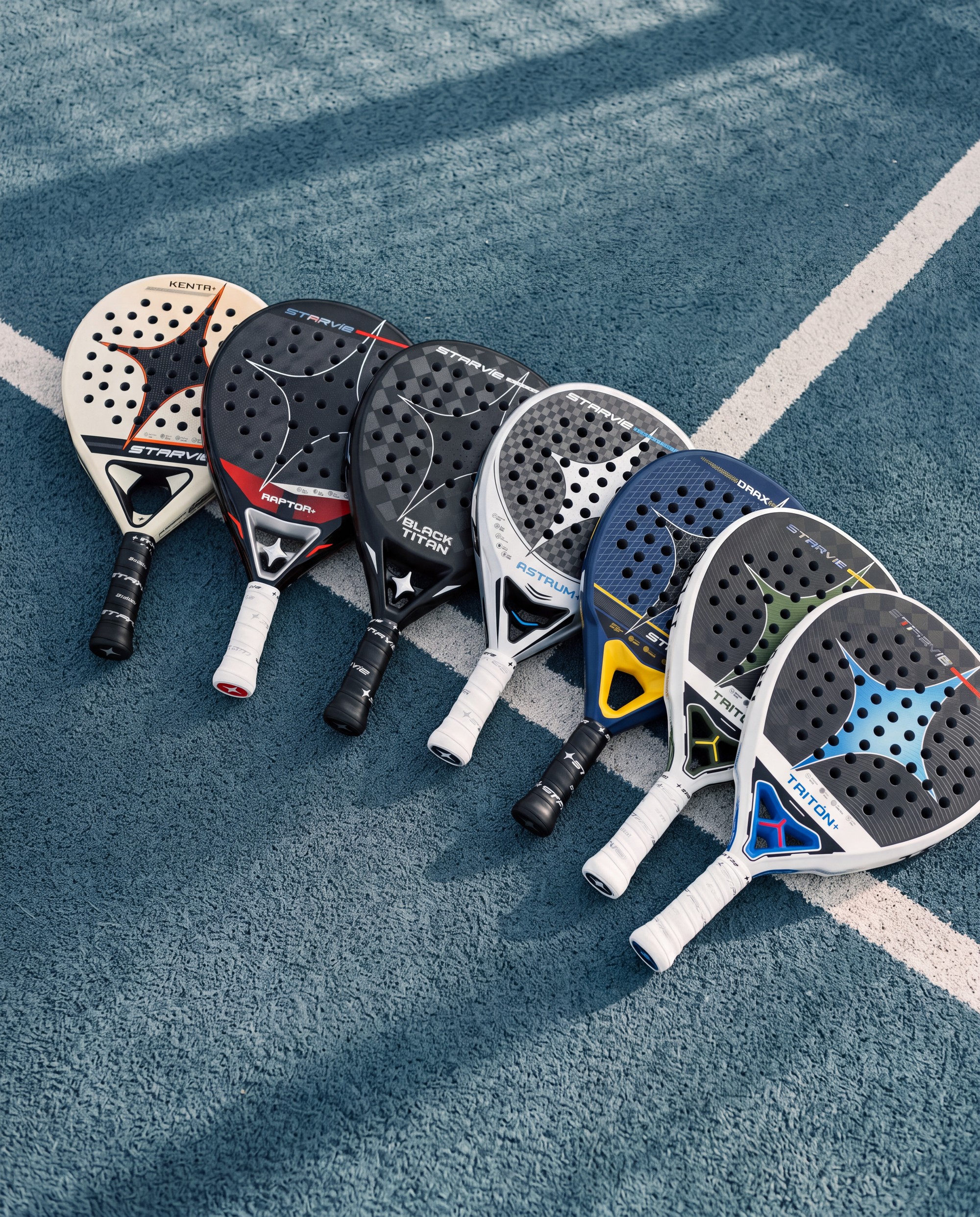
The StarVie Padel Racket Lineup, Decoded
StarVie ships seven rackets in their 2026 top-tier range and puts no family labels on the packaging. Kenta, Astrum, Raptor, Drax, Triton Balance, Triton Power, Black Titan — seven names, one wall. The system is not complicated once you see it: shape is your first question and hardness within that shape is your second. Pick both and the right racket names itself.
StarVie arrives without a family label system. Walk up to a 2026 display and you see seven names: Kenta, Astrum, Raptor, Drax, Triton Balance, Triton Power, Black Titan. No Pro and Elite, no tier badge, no color-coded player level. Just names. The logic is underneath the names, not stamped on them. Shape tells you the intent of the frame. Carbon grade and core hardness tell you how demanding that frame is. Those two axes cover all seven models and let you pick without hitting a single ball.
Three shapes, three directions
The Kenta is the only round in the 2026 range. Round means the sweet spot is wide and centered, the balance sits toward the grip, and the pala is built to absorb before it fires. StarVie put a soft S-EVA Flex core inside the Kenta — the only soft foam in the entire top-tier lineup — and faced it with 12K carbon with a textured surface. The result is StarVie's most forgiving frame: comfortable from the back, reliable on salida de pared, maneuverable at the net. It is not a finishing racket. It is a racket that keeps you in the point while you build to the right ball.
Three models sit in the teardrop shape: the Astrum, the Raptor, and the Drax. All three share the same M-EVA Balance medium-hard core, so the base hardness across that cluster is similar. What separates them is intent: where the sweet spot sits, how aggressively the face bites, and whether the frame rewards an attack or a build. Medium balance on all three keeps the head manageable and the hand fast enough that StarVie can put both the most forgiving teardrop (Raptor) and the most attack-tilted one (Drax) into the same shape family without contradiction.
The top end of the range goes to three frames in diamond or near-diamond shapes: the Triton Balance, the Triton Power, and the Black Titan. All three carry more head weight than the teardrops, all three are built around the point-ending smash, and all three demand that the player make clean central contact to get the most out of the carbon face. The Triton Balance is the entry into this zone. The Black Titan is the hard ceiling. The Triton Power sits between them.
Inside the three teardrops
The Astrum is the all-court teardrop with an attack lean. The sweet spot sits high in the face, compact and precise, and the 12K carbon face with StarVie's Full Plane Effect rough surface bites on bandejas and mid-court víboras. If you use the net to end points and want a pala that rewards well-timed contact with a clean finish rather than raw pace, this is where to start among the teardrops. Mistimed contact shows up quickly — the Astrum does not protect the player who arrives late.
The Raptor is the teardrop with the widest sweet spot in the 2026 lineup. The mold moved from a round in the previous generation to a teardrop here, but the forgiving contact zone stayed. StarVie installs a Dynamic Star removable bridge insert — a 12-gram piece that, left in, adds swing stability and smash mass; removed, it makes the frame lighter and more agile for a different feel from the same pala. The Raptor is also consistently described by reviewers as the fastest-moving frame in the 2026 range. If you are transitioning out of a control racket and want a teardrop that does not immediately punish early timing errors, this is the most accessible entry in the cluster.
The Drax sits at the attack end of the teardrop cluster. A pronounced X-pattern 3D roughness on the face grabs the ball more aggressively than the Astrum's Full Plane Effect, and that bite translates into better spin loading on the víbora and crisper cut bandejas. The sweet spot is broader than the Astrum's but the frame's intent skews toward active, attacking play. Players who build points from the left side on the backhand and prepare early will find the Drax more rewarding than the other two teardrops. It sits closest in character to the Triton Balance below it on the hardness scale.
The Triton split: same diamond, two cores
The Triton Balance and the Triton Power share the same 18K carbon diamond mold. Same shape. Same face carbon grade. Same Spin Boost 3D surface texture. The only variable StarVie changes between the two is the core: M-EVA Balance in the Balance, and a tri-density H-EVA Power TriTech sandwich in the Power. That single change turns one geometry into two meaningfully different playing experiences. Think of them as adjacent positions on a spectrum, not as interchangeable versions of the same racket.
The Triton Balance is the softer sibling. The M-EVA core keeps the rebound slightly more open, the sweet spot feels enlarged relative to what a diamond shape typically delivers, and the face texture makes the víbora and bandeja its most confident shots — the ball sits on the face long enough to load cut and spin. It is the most forgiving way into StarVie's diamond line. If you want to play an attacking game with a diamond shape but do not yet land every smash on center, the Balance is the correct entry.
The Triton Power is the performance step. The TriTech tri-density core layers soft, medium, and hard EVA into a sandwich that limits vibration while still delivering a dry, direct smash response. Despite the diamond shape and the harder core, the Power is unusually maneuverable: sub-360 g weight and a measured balance of 263 mm keep the head fast enough for reflex volleys. StarVie deliberately tuned this generation as a more accessible ceiling than the previous Triton Pro, so advanced-improver players who make clean central contact consistently will find it rewards them without requiring a fully locked technique.
The Black Titan: outside the naming system
The Black Titan sits outside the Triton naming family and outside the other six models in terms of raw demand. StarVie calls the shape a hybrid — somewhere between a teardrop and a diamond — and faces it with 24K carbon master grade, the stiffest face in the range. The core is H-EVA Power at full hard density. The Dynamic Star removable insert is fitted as standard. At 368 g, the smash carries real penetrating pace and a kick on the kick-smash that the Triton Power cannot match. The 24K face and hard core together make it the heaviest-hitting frame StarVie currently makes.
What that hardness costs: passive touches come back flat. Defense off the paredes requires active stroke intent or the ball dies short. If you expect the pala to manage a reset for you, the Black Titan will expose that habit. The correct player here is an experienced, heavy-swinging attacker who commits to every ball and uses the frame as a finishing tool rather than a problem-solver. It is not a racket for players who are still developing consistency from the back.
How to pick in two sentences
First, pick your shape by how you intend to win the point. Defend and build from the back until you get the right ball: Kenta. Attack and defend equally, building through the point with placement and spin: Astrum, Raptor, or Drax. Finish points at the net with the smash as your primary weapon: Triton Balance, Triton Power, or Black Titan.
Second, pick your hardness by how consistently you make clean central contact over a full match. Soft, wide, and forgiving: Kenta. Most generous sweet spot in the teardrop range: Raptor. Precise all-court teardrop with a net lean: Astrum. Attack-tilted teardrop, spin-first: Drax. Forgiving entry into the diamond line: Triton Balance. Demanding diamond with an accessible ceiling: Triton Power. Expert-only attacking ceiling: Black Titan.
One thing worth checking on any StarVie you handle: whether the Dynamic Star bridge insert is fitted and whether you want to run it. On the Raptor and the Black Titan, removing the 12-gram insert lightens the frame noticeably and biases it toward agility; leaving it in adds stability and some smash mass. The same model can play meaningfully differently depending on that choice alone. Worth two minutes with the tool before you step on the court for the first time.
The StarVie Padel Racket Lineup, Decoded