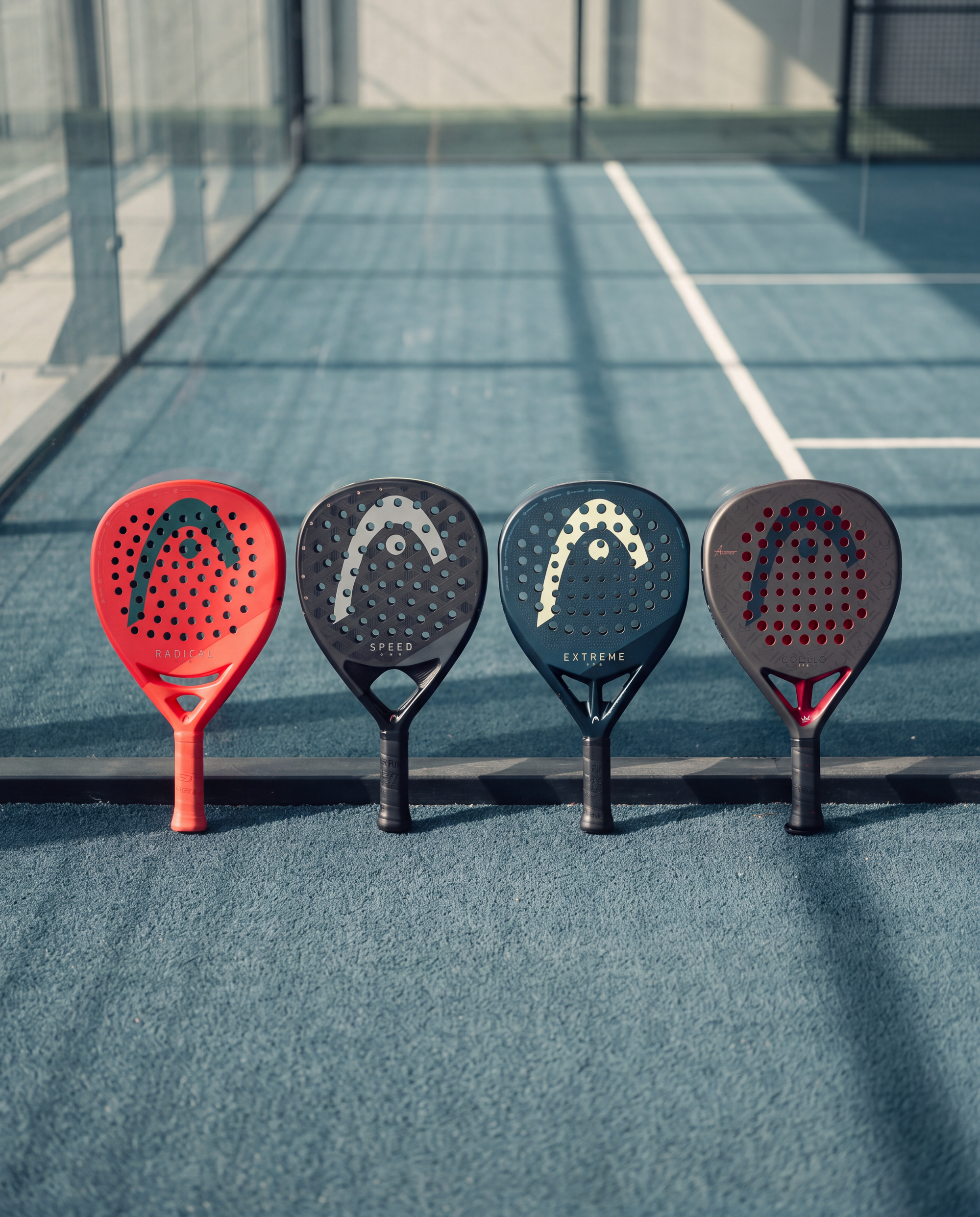
The HEAD Padel Racket Lineup, Decoded
HEAD sells four padel families in the shapes you actually see on the wall (Radical, Extreme, Speed, Coello) and stacks up to seven variant tiers inside each one. It looks like a memorization test. It is a two-axis grid. This guide sorts family by play style and tier by how demanding the frame is, so you can name your racket in two sentences before you ever hit with it.
Walk into a pro shop and the HEAD wall does its usual trick. Fifteen frames, four families, seven variant words stamped across them: Pro, One, One X, Motion, Team, Team Light, Vibe. It looks like a memorization test. It is not. The whole HEAD range fits on a two-axis grid, and once you see the grid you can name your racket in two sentences. That is what this piece is for.
Family is the play style, and shape is the tell
Four families sit inside the range you will actually see on the wall: Radical, Extreme, Speed, and Coello. Shape sorts them cleanly.
Radical is a teardrop, control-led. Precision first, with enough pop when you accelerate. The teardrop mold and firmer face let you place the ball into tight windows without giving up offense. Radical Pro is 370g with a 260mm balance: heavy on the scale, unusually maneuverable in the hand because the mass sits low near the grip.
Extreme is the diamond, tuned for power. This is HEAD's finishing frame, built to end points above the net. Extreme Pro is 370g / 272mm: same weight as the Radical Pro, opposite feel, because those twelve extra millimeters of balance push mass into the head.
Speed is the other teardrop, tuned all-court. It rewards a player who wants to attack and defend equally. Speed Motion at 355g / 270mm is the family's honest middle: a bridge between power and control that does not pretend to be either extreme.
Coello is the second diamond, and the most power-forward of the four. It is Arturo Coello's signature line, 370g / 272mm on the Pro, aimed at players whose main job is finishing points at the net with a smash or a víbora.
(HEAD also makes a fifth family, Gravity, in a round shape for defense and arm comfort. It sits outside the four you will usually see stacked together, so we leave it aside for this decision.)
Tier is how much racket you can actually swing
Inside each family, the tier controls weight, balance, and how forgiving the layup is. From most demanding to most friendly:
Pro is tournament weight, around 370g, full carbon, with Power Foam (Control Foam in Radical). It is made for players who can swing it for two hours without losing shape.
Motion carries the same architecture as the Pro but drops 10 to 15 grams. It moves faster through the air and asks less of the shoulder over a long match. Balance stays close to the Pro, so the family character does not shift.
One and One X are the intermediate power step. One X models add HEAD's newer 2D Carbon HS hitting surface and sit near the top of the family for raw output. One is the lighter, more approachable step-in.
Team softens the layup, often with a fiberglass face element, for a larger effective sweet spot and more comfort on off-center hits. You give up a little peak power for a lot more forgiveness on the paredes and off the frame.
Team Light is Radical-specific in the current lineup. Think of it as the Radical Team with a further weight reduction, aimed at players who want the Radical feel without the physical cost. Do not look for it in the Extreme or Speed range; it is not there.
Vibe is the fiberglass entry point. Oversize teardrop, roughly 355g at 265mm balance, the softest feel in the family and the easiest place to start.
Reading the grid without hitting a single ball
The step between Pro and Motion is real and consistent across the range. Extreme goes 370 to 360 to 345g through Pro, Motion, and One. Radical goes 370 to 355g through Pro and Motion. Ten to fifteen grams is not marketing garnish; that is one clean set on tired shoulders.
Balance encodes intent more than weight does. Extreme Pro at 272mm feels head-heavy and wants to finish. Radical Pro at 260mm carries the same 370g but sits lower in the hand and swings faster than the scale suggests. When you are choosing between two HEAD rackets, the number to check first is millimeters of balance, not grams of weight.
Where the grid gets interesting is at the intermediate tier, because Speed Team and Radical Motion are both around 355g teardrops in a similar bracket. Same shelf, different tactical futures. Speed Team, near 270mm with Power Foam, rewards a player transitioning to the red. Radical Motion, at 260mm with Control Foam, rewards a player who wins by placement and salida de pared. Pick the balance number that matches how you win the point.
The other question players run into is Extreme One versus Speed One X. They land in the same weight zone, roughly 345 to 365g, so weight will not separate them. Family purpose will: Extreme One is for the player who wants to finish, Speed One X is for the player who wants to attack and defend equally.
How to pick, in two sentences
First, name your family by how you want to win a point. Finish at the net: Coello or Extreme. Do everything: Speed. Win by placement and tactics: Radical.
Second, name your tier by how much racket you can honestly swing well for two hours. Starting out or protecting the arm: Vibe or a Motion. Improving intermediate: Team, Team Light (Radical only), or One. Heavy-swinging advanced or tournament player: Pro, or One X if you specifically want the 2D Carbon HS profile.
Before you commit, glance at the balance in millimeters. A number in the 260s means grip-heavy and maneuverable. A number in the 270s means head-heavy and power-biased. If the balance matches your intent, that is your racket.
The HEAD Padel Racket Lineup, Decoded