What Padel Racket Foam Names Actually Mean
Padel spec sheets throw EVA, MultiEVA, HR3, X-EVA, Power Foam, Soft Performance EVA, and plain FOAM at you as if each were a distinct material. They are not. There are two real polymer families, a handful of density grades, three construction patterns, and a lot of brand names sitting on top. Here is what actually differs between padel racket cores, what is a marketing wrapper on the same thing, and what any of it means once the ball hits the face.
Two rackets sit on the shop wall. One says MultiEVA. The next says Soft Performance EVA. A third says HR3. A fourth just says FOAM. Are these four materials, or one material described four ways? The answer is closer to the second: two real polymers, a few density grades, a couple of construction patterns, and a lot of brand vocabulary sitting on top. Once you know how the pieces fit, spec sheets stop being noise.
The two families that actually matter
Every modern padel core is built from one of two polymers.
EVA (ethylene-vinyl acetate) is the default. Closed-cell, rubbery, dense feel. The same base polymer is tuned to Soft, Medium, and Hard grades by adjusting the vinyl-acetate ratio and the molding pressure. It lasts, it stays dimensionally stable, and it comes in any hardness you might want. A quick identification trick: look through the small holes in the frame. If the foam inside looks smooth, that is EVA.
Polyethylene, usually marketed as FOAM or Soft Foam, is a different polymer entirely. Softer feel, more sensation of the ball leaving the face, better vibration absorption. Impact testing has shown polyurethane-family foams cut peak force transmission by roughly 28.6% compared with EVA. The trade-off is lifespan: polyethylene deforms faster and is more prone to cracking the frame over time. Look inside those same holes; if the foam looks bubbly and porous, it is polyethylene. Royal Padel's M27 Poly is the canonical example.
One clarification worth pinning down. Soft Foam and Soft EVA are not the same thing. Soft EVA is a low-density grade of EVA. Soft Foam, or plain FOAM on a spec sheet, almost always means polyethylene. Two rackets both labelled 'soft' can behave very differently depending on which family they come from.
Three ways brands build the core
Once you have the polymer, there is still the question of how it is arranged inside the frame.
Single-density is the simplest: one block of one foam, edge to edge. Predictable feel across the whole face. Most control-first and entry rackets sit here.
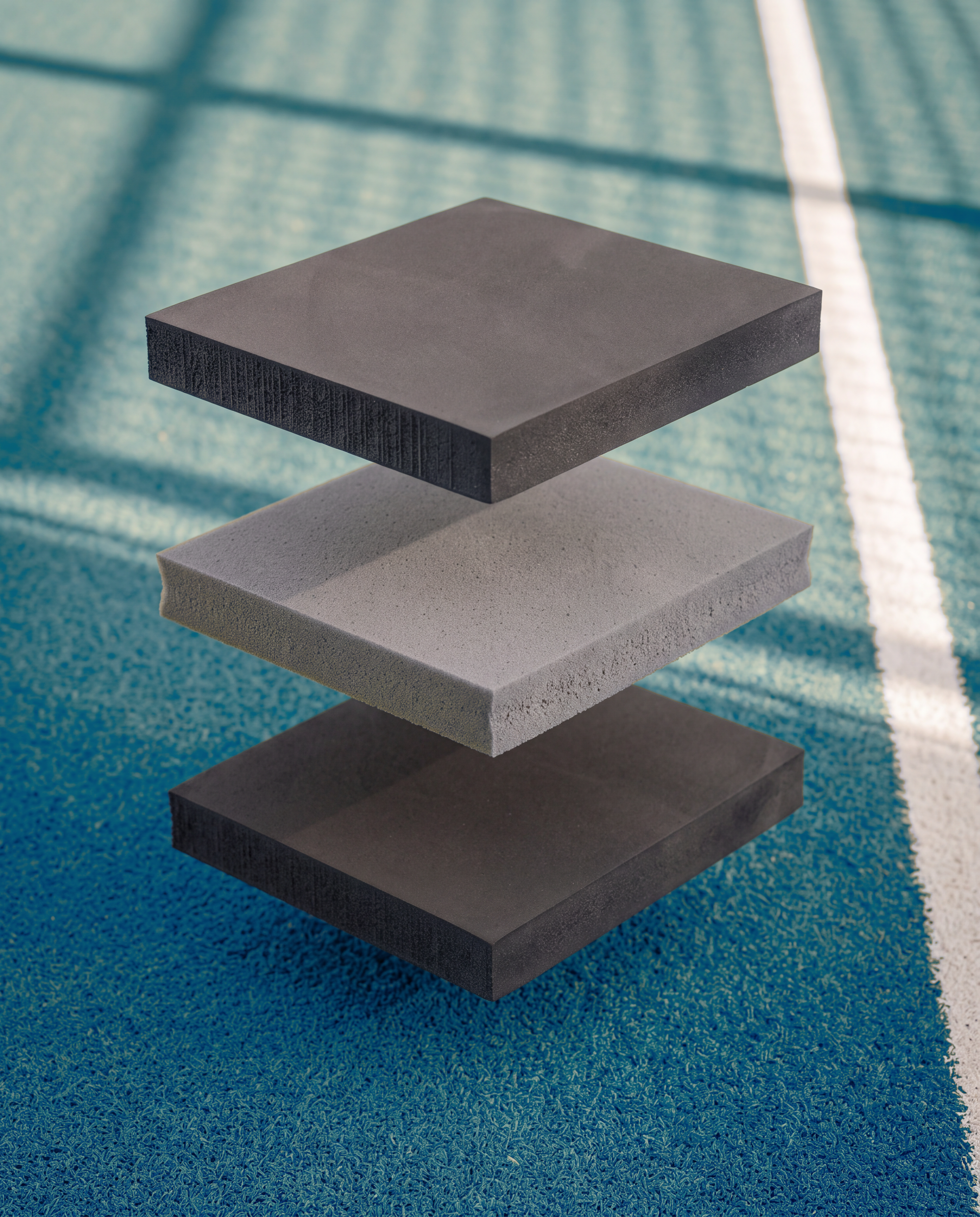
Sandwich, or layered, is the pattern Bullpadel calls MultiEVA and Babolat calls X-EVA. Three layers of EVA at different densities: two harder outer layers for explosive shots, one softer inner layer for cushioning and vibration damping. The design goal is to soften the classic power-versus-comfort trade-off. Hard outer for the ataque, soft inner for the touch shots and the arm. Two major brands independently landed on the same architecture with the same rationale, which is about as much confirmation as this category needs.
Dual-density is the same idea rotated ninety degrees. Different densities placed in different zones of the face, arranged laterally rather than in horizontal layers. Nox's Dual Density Core is the reference example.
The brand name decoder
With those two variables set (polymer family and construction pattern), the marketing names collapse into a small number of real categories.
- MultiEVA (Bullpadel) and X-EVA (Babolat) are the same architecture in different livery: three-layer EVA sandwich, hard outer, soft inner.
- HR3 (Nox), Black EVA and MLD Black EVA (Nox), and Soft Performance EVA (Adidas) are all proprietary EVA density tunes. HR3 comes in Soft and Hard variants and is engineered for a high memory effect. Despite the name, HR3 is EVA. MLD Black EVA is a multilayer high-density formulation aimed at warm climates, where its stiffness resists heat-softening. Soft Performance EVA is Adidas's softest core, low density, high rebound, tuned for comfort and ball exit.
- Power Foam (Head) is a proprietary reactive core positioned for smash and finishing shots. Still EVA family, single-formulation, engineered for maximum energy transfer.
- Polyethylene, FOAM, or Soft Foam on a Royal Padel or similar spec sheet is the other polymer family entirely. Softer touch, more damping, shorter lifespan.
If you take one thing from this section: when comparing across brands, translate the marketing name into its category before you compare feel.
What density and rebound do on court
Softer, lower-density cores compress more on impact. The ball stays on the face longer, the effective sweet spot spreads out, and you get more time to shape shots. This is the feel players describe as control and spin bite. Harder, higher-density cores compress less, return energy faster, and concentrate the response into a smaller sweet spot. Off-centre contact on a hard core feels dead and twists the frame; off-centre contact on a soft core is more forgiving.
Here is the counterintuitive part. A soft racket gains ball speed on soft shots and loses it on hard shots. A hard racket does the reverse: loses speed on soft shots, gains it on hard shots. The core only fires when the input matches what it is tuned to accept. That is why 'hard equals powerful' is only half true. Hard cores produce power when the player brings the swing speed to load them. Anything less and the ball comes off slower than a well-tuned soft core would send it.
Also worth separating: hardness is what the racket feels like on contact. Rebound is how much energy comes back out. They correlate loosely, but not perfectly. A well-tuned soft or medium EVA with a high-rebound formulation, HR3-style, can return more energy than a cheap Hard EVA that stiffens the feel while dissipating the input as heat.
Comfort and the elbow
Softer cores transmit less vibration into the arm. If you are managing epicondylitis or you know your elbow is your limit, moving from a hard, heavy racket to a softer, lighter one is one of the biggest single changes you can make.
Two nuances. Comfort at the core is separate from comfort at the handle. StarVie's Noene Inside sits in the grip. Babolat's Vibrabsorb System 2 sits in the carbon layup and handle. If arm comfort is your priority, both levers exist and it is worth knowing which one a given racket pulls. Second, comfort is not the same as weak. A soft-inner sandwich core loses very little finishing power once your swing is fast enough. What you gain is a wider band of comfortable contact.
Cold mornings, hot afternoons
Every foam stiffens in the cold and softens in the heat. This is not a small effect. Below about 10°C, Hard EVA can feel boardy, rebound drops, the sweet spot shrinks, and vibration climbs. In hot conditions, everything softens: contact stretches out, control improves, top-end power drops slightly.
If you live in a climate with big seasonal swings, one common piece of coaching advice is to own two rackets of different core hardness, or to default to intermediate and softer cores that stay closer to their reference feel across a wider band. In warm, humid climates like Bali, the guidance flips slightly: firmer cores like MLD Black EVA hold their character better through the heat, and very soft cores can feel even softer than their spec suggests.
What to actually do
Four decisions the next spec sheet cannot confuse you on.
- If maximum arm comfort is the priority and you are willing to replace rackets more often, look at polyethylene FOAM cores. Softest feel, best damping, shortest life.
- If you want power and forgiveness in a single racket, look at sandwich constructions: Bullpadel MultiEVA, Babolat X-EVA. Hard outer, soft inner is the no-compromise architecture.
- If you want durability, wide adjustability, and a mainstream spec, pick single-density EVA in the density that matches your swing speed. Soft EVA for slower or technique-first play, Hard EVA for aggressive finishers, Medium for most players between 3.0 and 4.0.
- If your climate swings hard through the year, default to a medium or soft-medium EVA core. HR3 Soft, MultiEVA, Soft Performance EVA. Hard cores punish cold weather the most; softer and medium cores stay closer to their reference feel across a wider band.
Two things worth setting expectations on before you shop. No manufacturer publishes Shore durometer numbers for padel cores, so every hardness claim in this category is qualitative; you are comparing marketing language across brands, not measurements. And 'memory foam' is not a padel core material. When you see 'memory effect' in the marketing copy, it points to a high-rebound EVA formulation, not the temperature-responsive foam you find in a mattress. Once you can spot a sandwich versus a single-density versus a polyethylene, most spec sheets read the same way.
What Padel Racket Foam Names Actually Mean