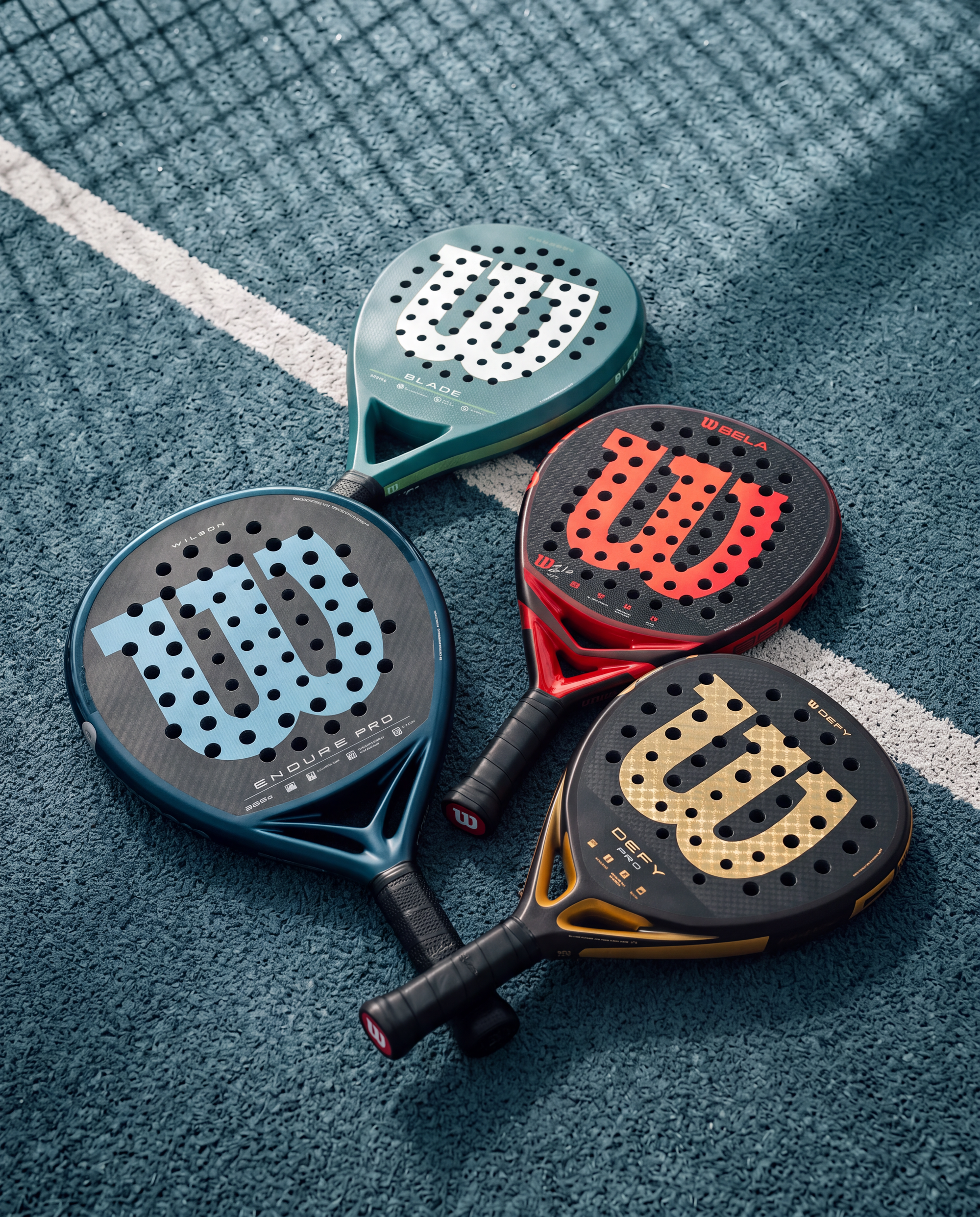
The Wilson Padel Lineup, Finally Sorted: Endure, Bela, Blade, Defy
Wilson's padel wall used to read like a random shelf. The 2025 relaunch is the first time the range actually maps to a player: four families, four shapes, four intents. This guide breaks Endure, Bela, Blade, and Defy down by who they're for, walks the Pro / standard / LS ladder inside each family, and names the caveats before you buy. Read it and you can pick a Wilson without hitting a single ball first.
For years, Wilson's padel wall read like a random shelf. Four names, no map, and no clear signal about who each racket was actually for. The 2025 relaunch is the first time the range sorts itself into a grid you can point at. Four families, cleanly separated on the two axes that matter: shape (round, teardrop, diamond) and intent (control, all-court, attack). By the end of this piece, you should be able to look at any of the twelve Wilson rackets on the wall and say who it's built for and why.
Four families, four players
- Endure is the placement player's round. Grip-heavy balance in the 255 to 260mm range, soft dual-density Control Foam+, and a raw-woven carbon face designed for feel over pop. Power is honestly capped around 6/10 across the whole family; control on the Pro is rated 10/10. If you measure success in your opponent's errors rather than your own winners, this is your family.
- Bela is Fernando Belasteguín's attacking but technical teardrop. Balance sits in the medium band (258 to 265mm), so it hits with pace without going full head-heavy. The whole point of the V3 generation is the Spin² Texture, a dual-layer surface that combines a molded 3D relief with a sandy topcoat. It attacks, but it also scores 8+/10 on control. A technician's power racket.
- Blade is the net-first all-courter. Teardrop shape, medium-to-high balance, and a small demanding sweet spot on the standard V4. The LS V4 opens the sweet spot up with a softer core and a lighter frame. Wilson's own European retail copy positions this family as more forgiving than the Bela range. Read it as a volleyer's frame, not a smash weapon: the bolea is where it earns its keep.
- Defy is the pure power diamond, and it's a new attacking format for the brand. Diamond shape across all three variants, head-heavy balance in the 263 to 265mm range, Power Foam core, Spin² Texture, and, on the Pro, the stiffest face in Wilson's current padel range (15K carbon). Co-signed with Javi Garrido, one of the harder hitters on the pro circuit. If Blade owns the volley, Defy owns the smash.
The Pro / standard / LS ladder inside each family
The variants inside each family now follow one clean rule: same DNA, softened and lightened as you step down.
Endure. Pro V1 (365g, 3K raw carbon, 260mm balance), V1 (365g, hybrid face, 255mm), LS V1 (355g, hybrid face and the softest foam in the line). Power stays capped around 6/10 across all three; maneuverability climbs as you descend the ladder.
Bela. Pro V3 (370g, 24K carbon, Power Foam), V3 (365g, 3K carbon, rigid-EVA-family core), LS V3 (355g, Comfort Flex composite face). Same Spin² surface on all three, which is a useful frame to act on: you can pick face stiffness and arm load independently from spin character. The spin ceiling does not drop as the price does.
Blade. V4 (365g, Firm EVA, small sweet spot, dry rebound), LS V4 (355g, Soft ECO EVA with a bio-based Bloom core, enlarged sweet spot). The V4 asks for clean contact; the LS is built to forgive it. Balance for the V4 sits in the medium-high band (roughly 265 to 275mm, not yet independently measured), and the LS reads closer to a straight medium.
Defy. Pro V1 (370g, 15K carbon, densest Power Foam), V1 (365g, 3K carbon, medium-hard Power Foam), LS V1 (355g, fiberglass Comfort Flex face). Interesting wrinkle here: the Defy LS still measures head-heavy at about 265mm, which is unusual for an LS variant. Wilson kept the attacking balance and used a softer face for arm relief instead of dropping the balance point. If you want the Defy identity with less shock into the elbow, the LS is the arm-friendlier route without giving up the offensive posture.
Where the tidy map still bends
The Bela "diamond" is not a classic head-heavy diamond. Balance sits at 260 to 265mm on the Pro and standard, not the 270mm-plus territory a true attacker occupies. Some spec databases even file them under teardrop. Read them as an oversize diamond that handles like a hybrid. If you buy a Pro V3 expecting to be pulled forward through your smash by the head, you'll be surprised how neutral it feels.
The Defy Pro's power is not automatic. At moderate swing speeds, the standard V1's 3K face returns more energy than the Pro's 15K face. The Pro rewards a fully committed swing; under-swing it and you're paying weight tax for output the standard already delivers. Match the racket to how hard you actually swing, not how hard you'd like to.
The Blade V4 is still under-tested. Independent hands-on data is thin, and there is no lab-measured balance point to quote with confidence. The LS V4 in particular has almost no independent play-testing beyond inference from the standard V4. Treat Blade recommendations for now as a working read, not a settled one; wait for measurements before you commit if you're indifferent between it and a Bela.
How to pick a Wilson in one minute
First, name your family by how you want to win a point. Placement and defensive precision: Endure. Spin and technique from both wings: Bela. Net control and forgiving voleas: Blade. Overhead power and finishing pace on the smash: Defy.
Second, name your tier by how hard you can honestly swing for a full match. Full committed swings all game: Pro. Steady club-level swings: the standard V1 or V3 or V4. Long matches, arm concerns, or a smaller and lighter player: LS. Wilson's LS tier this generation is genuinely comfort-tuned, not a cosmetic weight drop.
One rule of thumb when in doubt between two families: buy the standard variant in the softer of the two. A Bela V3 forgives more than a Defy Pro V1. An Endure V1 forgives more than a Blade V4. Comfort you'll actually use beats a spec sheet you won't.
The Wilson Padel Lineup, Finally Sorted: Endure, Bela, Blade, Defy